Difference Between Joining a Brokerage and Joining a Real Estate Team
Every real estate agent eventually reaches a point where they ask an important question:
Should I simply join a brokerage, or should I join a real estate team?
At first glance, those two options might seem very similar. After all, every real estate team operates under a brokerage, and both provide the legal framework needed to conduct business.
But after working with agents at different stages of their careers, I've learned that the day-to-day experience can be dramatically different.
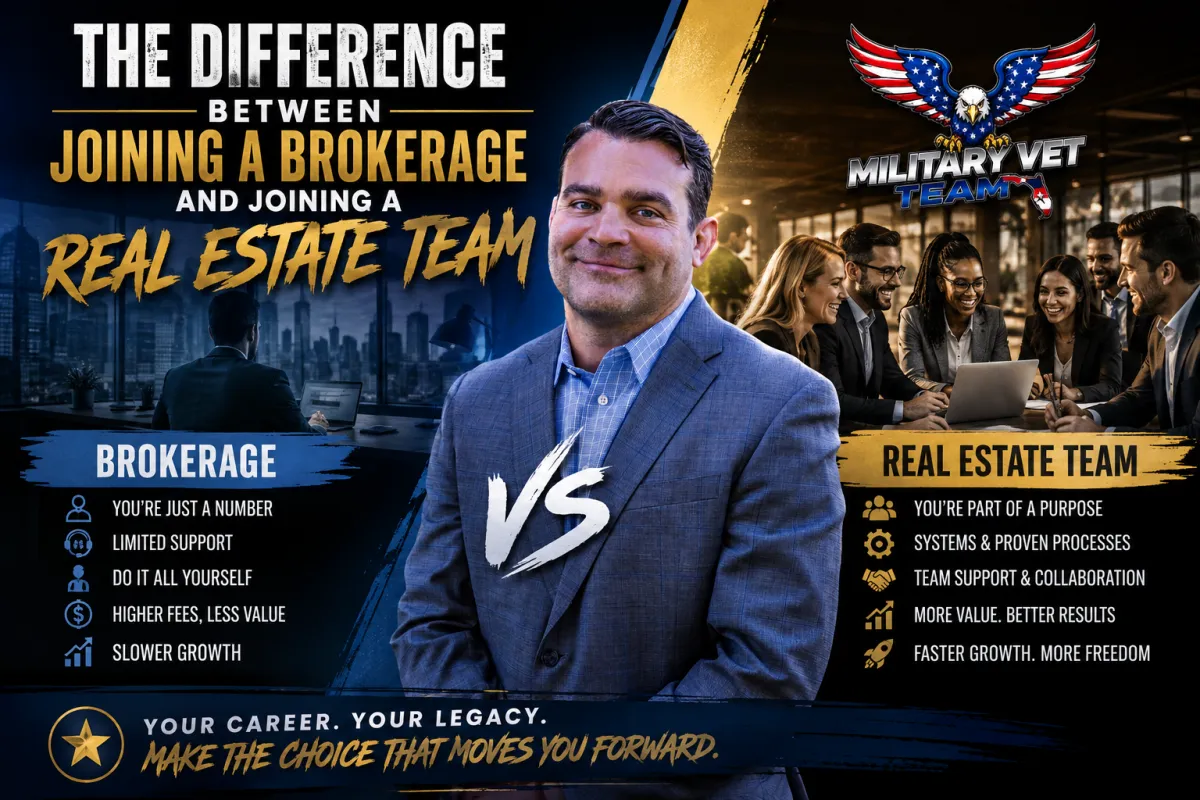
A brokerage provides the foundation for your business. A great real estate team builds on that foundation with additional leadership, mentorship, systems, accountability, operational support, and community.
Neither model is inherently better for every agent. The key is understanding what each offers and determining which environment aligns with your goals.
What a Brokerage Typically Provides
Every brokerage plays an essential role in helping agents operate legally and professionally.
Most brokerages offer resources such as:
Broker supervision and compliance
Transaction processing
Commission management
Brand recognition
Basic technology platforms
Marketing resources
Contract support
Licensing oversight
Continuing education opportunities
These services create the structure agents need to run their businesses.
For many experienced agents with established systems, that may be exactly what they need.
But for others, especially those looking to accelerate their growth or avoid building everything from scratch, they may want more than a brokerage alone can provide.
What a Real Estate Team Adds
A strong real estate team builds another layer of support on top of the brokerage.
Instead of simply providing a place to hang your license, a team often provides an environment designed to help agents grow professionally.
That may include:
Daily mentorship
Leadership coaching
Structured onboarding
Accountability
Administrative support
Collaboration
Marketing assistance
Technology implementation
Transaction coordination
Business planning
Community
The goal isn't to replace your independence.
It's to remove unnecessary obstacles so you can focus on serving clients and building your business.
Leadership Makes the Biggest Difference
One of the greatest advantages of joining a strong team is access to leadership.
Great leaders don't simply answer questions.
They help agents think differently.
They share experience.
They coach through challenges.
They create accountability.
They celebrate progress.
And perhaps most importantly, they continue developing future leaders.
Leadership shortens the learning curve.
Instead of figuring everything out through trial and error, agents benefit from the experience of professionals who have already navigated similar situations.
Mentorship Accelerates Growth
Real estate is a business where experience matters.
Every transaction teaches something new.
Inspection issues.
Appraisal challenges.
Financing delays.
Negotiation strategies.
Changing market conditions.
Having experienced professionals available to guide those conversations can make an enormous difference.
Mentorship isn't about creating dependence.
It's about creating confidence.
The right mentor helps agents become more capable, more knowledgeable, and more prepared to handle future situations independently.
Accountability Creates Consistency
One of the biggest challenges many agents face isn't knowledge.
It's consistency.
It's easy to stay motivated after closing a transaction.
It's harder to maintain productive habits during slower periods.
That's where accountability becomes valuable.
Many successful teams provide:
Goal setting
Performance tracking
Coaching conversations
Business planning
Regular check-ins
Skill development
Accountability isn't about pressure.
It's about helping agents stay focused on the activities that move their businesses forward.
Administrative Support Gives Agents More Time
As production increases, so do administrative responsibilities.
Without support, agents often spend more time managing paperwork than serving clients.
That's why many teams invest in operational infrastructure that helps agents remain productive.
Administrative support may include:
Transaction coordination
Compliance management
Listing support
Marketing assistance
Document management
Scheduling
Vendor communication
Deadline tracking
When operational professionals handle those responsibilities efficiently, agents gain more time for prospecting, relationship building, negotiations, and client service.
Community Matters More Than Many Agents Realize
Real estate can be an incredibly rewarding profession.
It can also be surprisingly isolating.
Working within a collaborative team environment creates opportunities to:
Share ideas.
Learn from experienced professionals.
Celebrate successes.
Solve challenges together.
Exchange market knowledge.
Encourage one another.
Strong communities create stronger professionals.
When agents know they're supported, they're often more willing to ask questions, seek feedback, and continue growing.
How MVT Combines Brokerage Resources With Team Support
The Military Veteran Team at LPT Realty is a good example of how a team can build upon the resources of a brokerage.
Agents receive the advantages of being part of LPT Realty while also benefiting from the additional structure and collaboration of a large, established team.
According to the MVT Organizational Handbook, the team emphasizes:
Leadership and mentorship
Structured training
Administrative support
Compliance assistance
Listing and marketing support
Advanced technology and AI tools
Collaboration across the organization
A servant leadership culture focused on helping agents succeed
This operational model allows agents to spend more time building relationships and serving clients while leveraging systems and resources that would be difficult for many individual agents to create on their own.
Proven Systems Create Confidence
One of the biggest advantages of joining an established team is gaining access to systems that have already been tested.
Instead of building every process from scratch, agents often benefit from proven workflows for:
Lead management
Client communication
Marketing
Transaction coordination
Business planning
Technology adoption
Accountability
Operational efficiency
Strong systems reduce uncertainty and create consistency.
That consistency allows agents to focus more on helping clients and less on reinventing their business every year.
Results Reflect the Strength of the Organization
One reason I encourage agents to evaluate operational systems—not just recruiting presentations—is because measurable results often reflect the strength of those systems.
In 2025, RealTrends Verified ranked the Military Veteran Team:
#1 Real Estate Team in Florida by Transaction Sides
#3 Real Estate Team in Florida by Sales Volume
#10 Real Estate Team in the Nation by Transaction Sides
#30 Real Estate Team in the Nation by Sales Volume
The team completed 1,352 verified transaction sides and $474.74 million in verified sales volume.
Those numbers aren't simply production statistics.
They represent thousands of client interactions supported by leadership, operational systems, administrative professionals, technology, and collaboration working together every day.
Which Environment Is Right for You?
Every agent's business is different.
Some professionals prefer complete independence.
Others thrive in a collaborative environment where leadership, accountability, mentorship, and operational support are part of everyday business.
Neither choice is universally right.
The important thing is finding an environment that matches your goals, your learning style, and the type of business you want to build.
As you evaluate your options, don't just ask about commission structures or brand recognition.
Ask questions like:
What kind of mentorship is available?
How accessible are team leaders?
What administrative support exists?
How are new agents onboarded?
What systems are already in place?
How is accountability handled?
What does the culture feel like?
How are agents supported as they grow?
The answers to those questions will often tell you far more than a recruiting presentation ever could.
Building More Than a Business
The best teams don't simply help agents close transactions.
They help them build sustainable careers.
That means surrounding people with experienced leaders, reliable systems, operational support, collaborative teammates, and a culture that encourages continuous improvement.
A brokerage provides the platform.
The right team can provide the environment that helps you maximize it.
If you're looking for more than a place to hang your license, take the time to evaluate the people, systems, and culture behind the organization.
Those are often the factors that shape long-term success.
Connect With Chris Vish
If you're exploring your next move in real estate and want to learn more about the leadership, systems, and collaborative culture behind the Military Veteran Team, I'd be happy to have a conversation. Let's discuss your goals and whether MVT could be the right fit for your business.